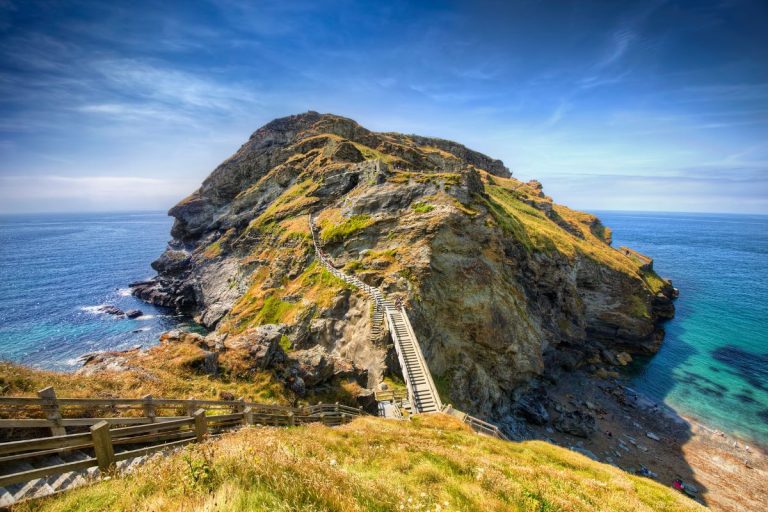
dirganews.com – The Cornish coastline represents a geological and cultural anomaly within the British Isles. Extending into the Atlantic as a rugged igneous and metamorphic protrusion, it serves as the primary buffer against the prevailing southwesterlies that define Northern European weather patterns. Engaging with this landscape through the lens of coastal trekking is not merely a recreational pursuit; it is an immersion into a complex maritime ecosystem where the transition from terrestrial stability to oceanic volatility is measured in vertical meters. The South West Coast Path, which traces this perimeter, acts as a thread connecting disparate historical epochs—from Neolithic settlements to the industrial scars of 19th-century tin mining.
To traverse these cliffs is to participate in a high-stakes dialogue between erosion and infrastructure. The trails are rarely static; they are subject to “Relict Landscapes” where the path underfoot may be several thousand years old, yet the cliff edge is retreating at a measurable annual rate. This creates a unique set of challenges for the long-distance hiker, requiring a sophisticated understanding of tidal influence, salt-spray aerodynamics, and the structural integrity of Devonian slate and granite.
As we move through 2026, the management of these trails has become a case study in “Adaptive Conservation.” Increased storm frequency and rising sea levels are necessitating a radical re-evaluation of how public access is maintained on a crumbling edge. For the serious practitioner, this means moving beyond the superficiality of “scenic walks” toward a disciplined approach to fieldcraft. This involves navigating the psychological weight of the “Exposure” (the proximity to vertical drops) and managing the physiological toll of constant salt-air dehydration. This definitive guide serves as a pillar of knowledge for those seeking to master the intricacies of the Cornish maritime frontier.
Understanding “Cliff Hiking in the Cornwall Coast”
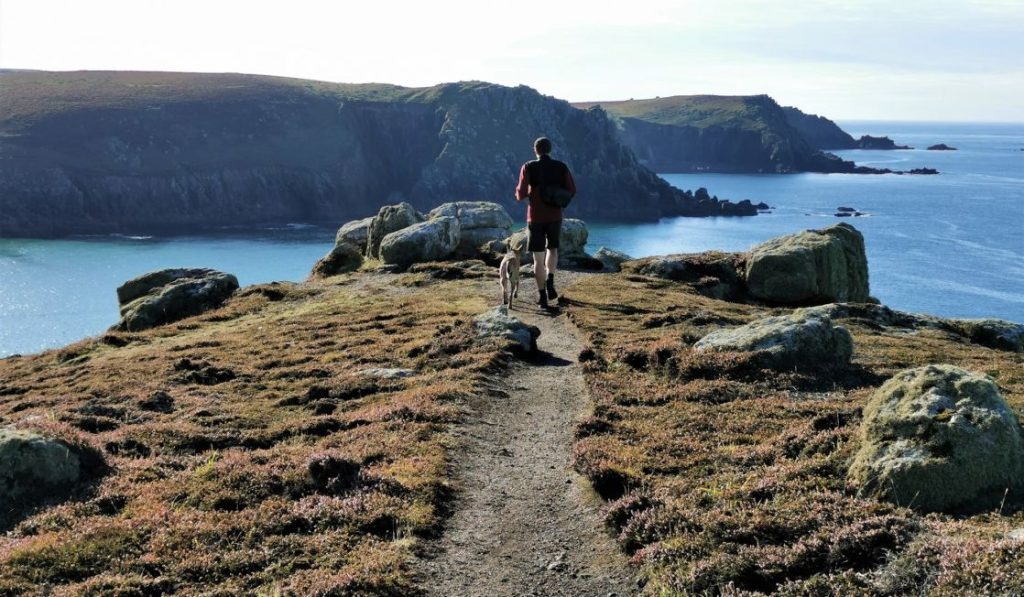
static.westcornwallwalks.co.uk
The term Cliff Hiking in the Cornwall Coast is frequently reduced in travel literature to a series of picturesque vistas. However, an analytical editorial perspective reveals that “Coastal Hiking” is a distinct sub-discipline of pedestrian travel with its own specific physics. The primary misunderstanding is the assumption that because the maximum elevation rarely exceeds 220 meters (approx. 720 feet), the physical demand is low. In reality, a 15-mile section of the Cornish coast can involve more total vertical gain than many mountain passes, as the trail drops into “combes” (valleys) and ascends back to the headlands repeatedly.
Multi-perspective understanding involves:
-
The Geological Perspective: Recognizing the “Hard” granite of West Penwith versus the “Soft” killas (slate) of the North Coast. This dictates everything from foot placement stability to the likelihood of sudden path subsidence.
-
The Maritime Perspective: Understanding that the “Micro-Climate” of the cliff edge is independent of inland weather. A mile inland may be calm, while the cliff edge experiences “Venturi Effects”—wind speeds accelerated by the vertical face of the cliff.
-
The Bureaucratic Perspective: The trail is a “Public Right of Way” that crosses private agricultural land. This creates a friction point between the “Right to Roam” and the practicalities of livestock management and coastal erosion.
Oversimplification risks lead to “Situational Blindness,” where hikers ignore tidal windows or overestimate their pace. A definitive reference recognizes that the cliff edge is a “Dynamic Boundary.” What was a safe path in April may be a “Fatal Fall Zone” in October following a period of saturation and frost-wedging.
Deep Contextual Background: The Geological and Industrial Palimpsest
The structural foundation of Cornwall was forged during the Variscan Orogeny approximately 300 million years ago. This tectonic event pushed granite batholiths into the overlying sedimentary rocks, creating the mineral-rich veins that would eventually drive the Cornish economy. When hiking the cliffs today, one is essentially walking on the “Roots” of an ancient mountain range that has been ground down by the Atlantic.
Historically, these cliffs were not recreation sites; they were “Observation Posts” and “Workplaces.” The South West Coast Path originated from the needs of the Coastguard in the 19th century to patrol for smugglers. They needed a path that hugged the edge so they could look down into every cove—a requirement that explains why the trail often takes the most difficult, exposed route rather than a more efficient inland path.
Simultaneously, the “Mining Landscape” transformed the cliffs into industrial zones. Sites like Botallack or Levant feature engine houses perched precariously on the precipice, with tunnels extending miles out under the seabed. To hike here is to traverse an “Industrial Wilderness.” The danger of hidden mine shafts (locally called “adits” or “winzes”) is a legacy that requires hikers to stay strictly on the established path. The evolution from a site of extraction and surveillance to a site of global tourism reflects a systemic shift in how the UK values its “Marginal Lands.”
Conceptual Frameworks and Mental Models
1. The “Energy Budget” Framework
Unlike mountain hiking, where energy is spent on a singular long climb followed by a descent, cliff hiking follows a “Sawtooth” pattern.
-
The Model: Energy is depleted in short, high-intensity bursts (climbing out of a cove) followed by “Active Recovery” (walking the flat plateau).
-
The Limit: If a hiker burns their “Glycogen Stores” too early on a high-frequency sawtooth section (e.g., the “Pentire to Port Isaac” stretch), they face a sudden, catastrophic drop in decision-making ability.
2. The “Tidal-Temporal” Intersection
This model evaluates the safety of a route based on the intersection of the tide and the speed of the hiker.
-
The Model: Many sections of the trail cross “Intertidal Zones” or beaches that are cut off by the rising sea.
-
The Application: A hiker must calculate their “Exit Point” based on the “Rule of Twelfths” (the rate at which tidal height changes).
3. The “Edge-Effect” Psychology
The proximity to a vertical drop creates a “Cognitive Load” that increases fatigue faster than inland walking.
-
The Model: The brain is constantly processing “Proprioceptive Feedback” to maintain balance against wind gusts and uneven ground.
-
The Limit: In high-wind conditions, the mental energy spent on “Fall Avoidance” can lead to “Sensory Overload,” causing the hiker to miss navigational cues.
Key Categories of Cornish Coastal Environments
| Category | Typical Terrain | Geological Base | Primary Risk |
| The North Coast Giants | High, sheer cliffs; large sandy bays. | Killas (Slate) | Coastal Subsidence / Landslips |
| The Granite West | Boulder-strewn; rugged; low vegetation. | Granite Batholith | Ankle Morbidity / Slick Rock |
| The Lizard Peninsula | Rare serpentine rock; complex coves. | Serpentine / Oceanic Crust | Navigational Disorientation |
| The South Coast Riás | Wooded estuaries; milder slopes. | Sedimentary / Mudstone | Mud/Slurry Slippage |
| The Mining Heritage Zone | Industrial ruins; sharp drop-offs. | Mineralized Veins | Hidden Shafts / Sharp Spoil |
Decision Logic: The “Weather Window”
The primary decision point for a Cornish hiker is the “Wind-Direction/Exposure” correlation. A North Coast hike in a Northerly gale is significantly more dangerous than the same hike in a Southerly wind, as the wind creates “Updraft Turbulence” that can literally lift a hiker off their feet at the crest of a cliff.
Detailed Real-World Scenarios
The “Zennor to St Ives” Endurance Trap
This 6-mile section is notoriously the most difficult on the entire 630-mile path.
-
The Constraint: There is no “Escape Road” for 6 miles. Once committed, the hiker must finish or turn back.
-
The Failure Mode: Starting this section at 3:00 PM in the autumn. The “Sawtooth” terrain slows the pace to 1 mph.
-
Second-Order Effect: Darkness falls while the hiker is in a boulder field, leading to a SAR (Search and Rescue) call-out.
The “Bedruthan Steps” Erosion Event
A hiker attempts to access the beach via steep stairs or path edges.
-
The Constraint: The “Soft” slate cliffs are prone to “Translational Slides” after heavy rain.
-
The Decision Point: Choosing whether to bypass a “Caution: Path Subsidence” sign.
-
Outcome: Ignoring the sign leads to a “Trapped on a Ledge” scenario as the path gives way behind the hiker.
The “Lizard Point” Fog Envelopment
The Lizard Peninsula is famous for “Sea Fret” (sudden maritime fog).
-
The Constraint: Zero visibility within 5 minutes.
-
Failure Mode: Relying on visual landmarks (lighthouses) rather than a compass.
-
Management: Transitioning to “Dead Reckoning” navigation, moving slowly away from the cliff edge toward the inland hedge-line.
Planning, Cost, and Resource Dynamics
Cliff hiking in Cornwall involves “Asymmetric Logistics.” While the trail is free to access, the cost of moving along it is dictated by the “Seasonality of Transport.”
Estimated Resource Table (2026 Projections)
| Expense Type | Cost (Daily Avg) | Variability Factor |
| Accommodation | $80 – $220 | High: B&Bs in “St Ives” vs. Hostels in “Penzance” |
| Logistics (Luggage Transfer) | $15 – $25 | Fixed: Per bag per leg |
| Food (Pub/Supply) | $40 – $60 | Moderate: Tourist hubs vs. village stores |
| Emergency Buffer | $500 (Set) | Essential for “Taxing/Short-notice Transport” |
Opportunity Cost: Choosing to hike “South to North” (clockwise) provides the prevailing wind at your back, but forces you to face the morning sun, which can cause “Retinal Fatigue” when reflecting off the Atlantic. This is a subtle but critical planning detail for long-term health.
Tools, Strategies, and Support Systems
-
Ordnance Survey (OS) Maps (1:25,000): The digital app is excellent, but physical maps are “EMI-Proof” and don’t suffer from battery death in cold, damp conditions.
-
Trekking Poles (Dual): Essential for the “Sawtooth” climbs. They reduce the impact on the patella by approximately 25% during steep Cornish descents.
-
VHF Marine Radio (Optional but Recommended): In deep “combes,” cell signal is zero. A VHF radio can reach passing ships or Coast Guard stations in an emergency.
-
Salt-Resistant Technical Shell: Most “breathable” membranes fail when salt crystals clog the pores. Frequent rinsing with fresh water is a necessary “Maintenance Strategy.”
-
Tide Table Apps (Local): Essential for crossing sites like “The Gannel” at Newquay or “St Michael’s Mount.”
-
“Luggage Freedom” Services: Utilizing third-party transfers allows hikers to carry a “Day Pack” only, significantly reducing the risk of “Weight-Shift Falls” on narrow path sections.
-
Personal Locator Beacon (PLB): For the solo hiker on the “West Penwith” section,s where human contact is rare.
-
The “Cornish Hedge” Shelter Strategy: Learning to use the ancient stone-and-earth walls as windbreaks during rest stops.
Risk Landscape and Failure Modes
1. Direct Operational Risks (The “Contact” Layer)
These are high-velocity, immediate threats that occur during the execution of a task. They are often the result of human error or immediate environmental shifts.
-
Physical Integrity Failures: Acute injuries, such as an ankle inversion on a Cornish granite boulder or a wildlife charge during a tracking expedition.
-
Technological Malfunction: The sudden failure of a “Single Point of Failure” (SPOF) tool, such as a GPS unit in a “Sea Fret” fog or a water filtration system in a remote eco-lodge.
-
Decision-Making Fatigue: The erosion of cognitive bandwidth due to cold, hunger, or “Exposure,” leading to a fatal miscalculation of a tide window or a predator’s distance.
2. Environmental and Biological Risks (The “Dynamic” Layer)
These risks originate from the unpredictability of the natural system itself. They are often outside the observer’s control but within their ability to mitigate through preparation.
-
Atmospheric Volatility: Micro-climate shifts, such as “Venturi Effect” wind gusts on a cliff edge or sudden “Flash Floods” in an arid safari biome.
-
Ecological Drift: The movement of a species out of a protected zone due to “Climate Envelope” shifts, rendering local conservation efforts obsolete.
-
Invasive Synergies: The “Invasive-Fire Cycle,” where non-native flora increases the intensity and frequency of wildfires, permanently altering the soil chemistry.
3. Systemic and Governance Risks (The “Structural” Layer)
These are slow-moving, low-visibility risks that undermine the long-term viability of a program or expedition.
-
The “Appropriations Cliff”: When a conservation program is legally mandated but the funding is not renewed, creating “Paper Parks” that have status but no protection.
-
Shifted Baseline Syndrome: A generational risk where the current state of a degraded environment is accepted as “the norm,” leading to lower standards for restoration.
-
Regulatory Friction: Changes in “Public Right of Way” or land-use permits that can shut down access to critical migratory corridors or hiking trails overnight.
Governance, Maintenance, and Long-Term Adaptation
The South West Coast Path is governed by a partnership between the National Trust, Natural England, and the South West Coast Path Association. This is a “Distributed Governance” model.
The “Path Integrity” Checklist:
-
Monitoring: Rangers conduct “Post-Storm Audits” to identify new cracks in the slate.
-
Adjustment Triggers: If a path is within 2 meters of a “Crest-Line Crack,” the trail is “Rolled Back” into the adjacent farm field.
-
Review Cycles: Annual assessments of “Step-Wear” on the steep valley sections.
-
Intervention: The use of “Cleft Oak” for fencing, which is more resistant to the corrosive salt air than treated pine.
Measurement, Tracking, and Evaluation
For the editorial hiker, tracking progress is more than “Steps Taken.” It is a measure of “Environmental Literacy.”
-
Leading Indicator: “Pace Decay.” If your speed drops below 1.5 mph, it indicates the terrain is more complex than your energy levels can sustain.
-
Lagging Indicator: “Joint Inflammation.” Post-hike swelling indicates a failure in “Pole Technique” or “Load Distribution.”
-
Qualitative Signal: “Flora Awareness.” Noticing the shift from “Gorse and Heather” to “Thrift and Sea Campion” indicates you are in a high-salt-spray zone, requiring more hydration.
-
Documentation Example: Keeping a “Wind-Log”—recording wind speed and direction at various headlands to build a personal “Atmospheric Model” of the coast.
Common Misconceptions and Oversimplifications
-
Myth: “The path is always a well-marked dirt track.” Correction: In West Cornwall, the path often disappears into boulder fields, ds where “Waymarking” is via white paint on rocks.
-
Myth: “You can always get a cell signal for maps.” Correction: The high granite cliffs act as a “Shield.” Signal is often only available on the highest peaks or 2 miles inland.
-
Myth: “The sea air is hydrating.” Correction: Salt air is an “Osmotic Dehydrator.” You need to drink 20% more water on the coast than you would for the same exertion inland.
-
Myth: “If the weather is sunny, the cliffs are safe.” Correction: Heat causes the slate to expand and crack, and “Summer Landslips” are common after sudden thunderstorms.
-
Myth: “TCoast Guard will always save you.” Correction: SAR operations are “Weather-Dependent.” In a Force 9 gale, a helicopter cannot winch from a cliff face. You are your own primary rescuer.
-
Myth: “Flip-flops are fine for a short walk to a cove.” Correction: The path to the cove is often the same “Sawtooth” terrain as the main trail. “Ankle Inversion” is the #1 cause of minor injuries.
-
Myth: “Snakes aren’t a problem.” Correction: The European Adder (Vipera berus) is common in the Cornish heathland. They are shy but will strike if stepped on during their sun-basking hours.
Ethical, Practical, and Contextual Considerations
The “Ethics of the Edge” involves the principle of “Minimal Trace.” Because the cliffs are so fragile, “Wild Camping” is strictly discouraged on the cliff edge as it accelerates erosion and disturbs ground-nesting birds like the Chough. Practically, hikers must also consider the “Socio-Economic Load” they place on small villages. During the 2026 season, “Overtourism” in hubs like Boscastle or Tintagel has led to “Pedestrian Congestion.” An ethical approach involves using the “Inland Loop” trails to bypass congested villages, supporting the “Hinterland Economy” rather than just the coastal “Honey-pots.”
Conclusion:
ClifHiking ithe n Cornwall Coast is a profound exercise in “Boundary Management.” It is where the terrestrial certainty of the UK ends, and the chaotic potential of the Atlantic begins. To hike here successfully is to accept that the land is “Borrowing” time from the sea. The mastery of this trail is found not in the completion of miles, but in the refinement of one’s judgment—knowing when to push through the wind and when to retreat inland. It is a landscape that demands intellectual honesty; the cliffs do not care about your itinerary or your gear. They only respond to the laws of gravity and erosion. In the end, the hiker who respects the “Vertical Limit” of the Cornish coast is rewarded with a perspective of time that only the ancient, battered rocks of the peninsula can provide.