dirganews.com – Nepal is a country known worldwide for its spectacular Himalayan landscapes, dramatic mountain valleys, and powerful rivers. From the high-altitude regions of the Himalayas to the lowland Terai plains, Nepal has a diverse geography that creates remarkable natural environments. However, the same geography also makes the country highly vulnerable to natural disasters, particularly floods, landslides, and debris flows.
A flood disaster in Nepal can develop rapidly and affect communities, transportation networks, agriculture, tourism infrastructure, and essential services. Heavy monsoon rainfall is one of the most important causes of flooding, but the country’s steep terrain, river systems, changing weather patterns, and development in vulnerable areas can increase the severity of flood events.
Flooding in Nepal is not limited to one region. Mountain communities may face sudden flash floods and debris flows, while settlements in the hills and Terai can experience river flooding after prolonged rainfall. Urban areas may also experience localized flooding when drainage systems cannot handle intense precipitation.
Understanding the causes and consequences of Nepal’s floods is important for travelers, residents, local authorities, businesses, and anyone interested in the country’s geography and environmental challenges. This article examines the major causes of flooding in Nepal, its social and economic impacts, safety considerations, disaster response, and the long-term recovery process.
Understanding Nepal’s Flood Risk
Nepal’s geographical structure plays a major role in its flood risk. The country extends from some of the world’s highest mountains to relatively low-lying plains within a comparatively short horizontal distance.
This dramatic elevation difference means that water can move rapidly from mountainous areas toward valleys and downstream plains. Rivers originating in the Himalayas can carry enormous amounts of water, sediment, rocks, and debris during extreme weather events.
Nepal’s major river systems include the Koshi, Gandaki, and Karnali systems. Numerous smaller rivers and streams connect to these larger networks.
During normal conditions, these rivers support agriculture, ecosystems, hydropower production, and communities. During periods of extreme rainfall, however, river levels can rise quickly.
The risk is especially significant during Nepal’s monsoon season. Rainfall between approximately June and September provides essential water for agriculture, but intense or prolonged rainfall can overwhelm rivers and drainage systems.
Mountainous Terrain and Rapid Water Flow
Nepal’s mountainous landscape creates a particularly complex flood environment.
Steep slopes can accelerate surface runoff. When rainfall falls on mountainsides, water may quickly enter streams and rivers rather than gradually infiltrating the ground.
This process can produce flash floods with very little warning.
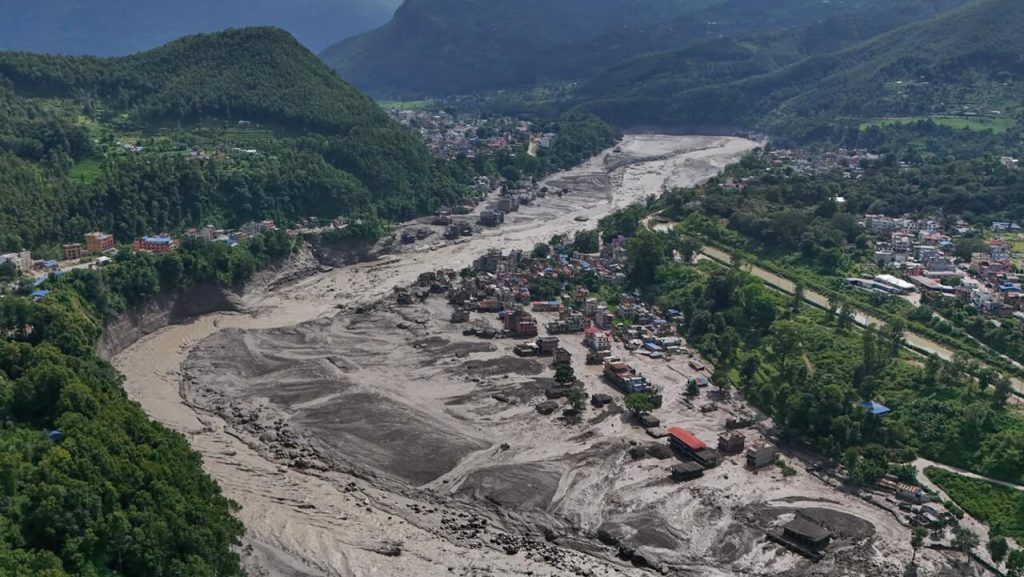
In addition, steep terrain is vulnerable to landslides. A landslide can temporarily block a river and create a natural dam. If the blockage later fails, a large volume of water can suddenly move downstream.
For communities living near mountain rivers, this combination of rainfall, landslides, and rapidly moving water can create serious hazards.
Major Causes of Flooding in Nepal
1. Heavy Monsoon Rainfall
The monsoon is the most important seasonal factor behind many floods in Nepal.
Large amounts of moisture move into the region during the summer monsoon. When rainfall becomes particularly intense, rivers can rise quickly.
Several consecutive days of rainfall can saturate the soil and increase surface runoff. Once the ground becomes saturated, additional rainfall is more likely to flow directly into rivers and drainage channels.
This can transform a normal river into a dangerous and rapidly expanding waterway.
2. Flash Floods
Flash floods are among the most dangerous flood events because they can develop quickly.
Unlike slower river flooding, flash floods may occur shortly after intense rainfall upstream. A community can experience dangerous water levels even when rainfall at that specific location appears moderate.
Mountain streams and narrow valleys are particularly vulnerable.
For travelers, this is an important consideration when hiking, camping, crossing rivers, or traveling through remote mountain areas.
A stream that appears shallow and safe during dry weather can become extremely dangerous after heavy rainfall upstream.
3. Landslides and Debris Flows
Flooding and landslides are closely connected in Nepal.
Heavy rainfall can weaken slopes, increase soil moisture, and trigger landslides. The resulting material can enter rivers and streams.
A debris flow may contain water mixed with mud, rocks, trees, and other materials. These flows can move with considerable force and cause severe damage to roads, bridges, homes, and infrastructure.
In mountainous areas, the distinction between a flood, landslide, and debris flow can sometimes become less obvious because they may occur as part of the same disaster sequence.
4. River Overflow
When rainfall causes rivers to exceed their capacity, water can spread into surrounding areas.
This is particularly important in the Terai region, where relatively flat terrain can allow floodwaters to cover large areas.
River flooding can damage agricultural fields, roads, houses, schools, businesses, and public infrastructure.
Communities living near rivers may face repeated flood exposure, particularly during severe monsoon seasons.
5. Urban Development
Rapid urbanization can increase flood risk.
As cities expand, natural surfaces such as soil and vegetation may be replaced by roads, concrete, rooftops, and other impermeable surfaces.
These surfaces prevent water from easily infiltrating the ground.
If drainage infrastructure is insufficient, intense rainfall can therefore produce significant urban flooding.
Poorly planned construction in flood-prone areas can further increase exposure.
6. Climate and Weather Variability
Changing climate conditions are another important consideration.
Climate change does not mean that every individual flood is caused by climate change. However, changes in temperature, precipitation patterns, extreme rainfall, glacier conditions, and other environmental factors can influence disaster risks.
For Nepal, understanding how climate patterns interact with its complex mountain environment is increasingly important for disaster preparedness.
Regions Vulnerable to Flood Disasters
Flood risk differs considerably across Nepal.
The Terai Region
The Terai is particularly exposed to river flooding because of its low elevation and relatively flat terrain.
Flooding in this region can affect large agricultural areas and densely populated communities.
Agriculture is especially important to local livelihoods, meaning that a major flood can have consequences extending well beyond immediate property damage.
Hill Regions
The middle hills face a combination of flooding and landslide risks.
Steep slopes and narrow valleys can concentrate water and increase the likelihood of rapid flooding.
Roads connecting hill communities can also be vulnerable because they often cross steep terrain and river valleys.
Himalayan Regions
High-altitude areas face different but potentially severe hazards.
Rapid snowmelt, extreme precipitation, glacial processes, landslides, and sudden changes in mountain waterways can contribute to downstream risks.
Remote communities may also have fewer transportation and emergency-response options, making disasters particularly challenging.
Human Impact of Nepal Flood Disasters
The most serious consequence of flooding is its impact on human life.
Floodwaters can destroy homes, isolate communities, damage roads, and disrupt access to food, clean water, healthcare, and electricity.
Families may be forced to leave their homes temporarily or permanently.
For vulnerable populations, including children, older adults, people with disabilities, and people living in isolated areas, evacuation can be especially difficult.
Flood disasters can also create secondary health risks.
When water systems are contaminated, communities may have difficulty accessing safe drinking water. Damaged sanitation infrastructure can further increase public-health concerns.
The consequences can continue long after floodwaters disappear.
Economic Impact of Flooding
A major flood can affect almost every part of a local economy.
Agriculture
Nepal depends heavily on agriculture for livelihoods and food production.
Floodwater can destroy crops, damage farmland, kill livestock, and wash away stored agricultural materials.
For farmers, a flood may therefore represent not only an immediate loss but also a significant reduction in future income.
Transportation
Roads and bridges are particularly vulnerable.
Floodwaters can erode road foundations, damage bridges, block highways with debris, and trigger landslides.
When transportation routes are closed, communities can become isolated.
This can make it more difficult to deliver food, medical supplies, fuel, and other essential goods.
Tourism
Tourism is a major part of Nepal’s economy.
The country attracts visitors interested in trekking, mountaineering, cultural tourism, wildlife, adventure travel, and spiritual experiences.
A serious flood can affect tourism infrastructure and transportation.
Trekking routes may become inaccessible, bridges may be damaged, and travelers may face cancellations or changing itineraries.
However, the effect on tourism is often temporary when infrastructure is repaired, and destinations recover.
Environmental Consequences
Flood disasters can cause significant environmental changes.
Strong water flows can erode riverbanks, remove vegetation, transport sediment, and alter river channels.
Landslides may destroy forests and agricultural land.
Floodwaters can also transport waste and pollutants into rivers and other ecosystems.
At the same time, floods are natural components of many river systems. Seasonal flooding can transport sediment and nutrients and contribute to ecosystem processes.
The challenge is particularly serious when human settlements and infrastructure occupy areas exposed to natural flood dynamics.
Nepal Flood Disaster and Tourism Safety
Travelers visiting Nepal should understand seasonal weather risks before beginning an adventure.
This is particularly important for people planning trekking, camping, rafting, or remote mountain travel.
Check Weather Conditions
Before traveling to remote areas, visitors should monitor weather forecasts and local warnings.
Conditions in mountain environments can change rapidly.
A favorable forecast at the starting point of a trek does not necessarily mean that conditions will remain safe along the entire route.
Avoid Crossing Flooded Rivers
One of the most important safety principles is simple: never attempt to cross a flooded river or stream simply because the crossing appears possible.
Fast-moving water can be much stronger than it looks.
Water depth can also change quickly, and submerged rocks or damaged bridges can create additional hazards.
Follow Local Instructions
Travelers should listen to local authorities, guides, accommodation providers, and trekking agencies during periods of severe weather. Residents often have valuable knowledge about river behavior, road conditions, and historically vulnerable areas.
Maintain Flexible Travel Plans
During the monsoon season, travelers should build flexibility into their itineraries.
Road closures, flight disruptions, landslides, and flooding can cause unexpected delays.
A flexible schedule can make it easier to change routes when conditions deteriorate.
Emergency Response During Flood Disasters
Effective disaster response depends on coordination between government agencies, local authorities, emergency services, humanitarian organizations, and local communities.
The priority is usually saving lives.
Search-and-rescue teams may need to evacuate people from flooded homes or isolated communities.
Emergency shelters can provide temporary accommodation for displaced families.
Food, drinking water, medical supplies, clothing, and sanitation equipment may also be required.
In remote areas, logistical challenges can make emergency response especially difficult.
Damaged roads and bridges may prevent conventional vehicles from reaching affected communities.
In such situations, helicopters or alternative transportation methods may become important.
The Importance of Early Warning Systems
Early warning systems can significantly reduce disaster impacts.
A warning system may involve rainfall monitoring, river-level sensors, weather forecasting, communication networks, and community alert mechanisms.
The technology itself is only part of the solution.
Warnings must reach people quickly, and communities need to understand what actions to take.
An effective early warning system should therefore connect scientific monitoring with local preparedness.
For example, if a river reaches a dangerous level, residents need clear information about whether they should evacuate, where they should go, and which routes are safe.
Community Preparedness
Local communities play a crucial role in reducing flood risks.
Preparedness can include identifying evacuation routes, establishing safe locations, preparing emergency supplies, and educating residents about warning signs.
Community-based disaster preparedness is particularly important in remote areas where emergency services may take longer to arrive.
Families can also prepare basic emergency kits containing drinking water, food, flashlights, batteries, essential medicines, important documents, and communication devices.
Rebuilding After a Flood
Recovery begins after immediate life-saving operations are completed.
However, rebuilding is not simply a matter of replacing what was destroyed.
A major disaster provides an opportunity to improve infrastructure and reduce future vulnerability.
Repairing Roads and Bridges
Transportation infrastructure is often among the priorities.
Restoring roads allows emergency supplies to reach communities and helps people return to work, school, healthcare, and normal activities.
Restoring Water and Electricity
Clean water and electricity are essential for recovery.
Damaged water systems can create serious health problems if not repaired quickly.
Power restoration can also support communications, healthcare, businesses, and households.
Supporting Farmers
Agricultural recovery may require seeds, tools, livestock assistance, financial support, and restoration of damaged farmland.
Because agriculture supports many rural families, helping farmers recover can have a major effect on the broader local economy.
Building More Resilient Infrastructure
One of the most important lessons from flood disasters is the need for resilient infrastructure.
Roads, bridges, buildings, drainage systems, and settlements should be designed with local environmental risks in mind.
Infrastructure planning should consider river behavior, rainfall patterns, slope stability, and historical flood zones.
In some areas, relocating vulnerable infrastructure may be more effective than repeatedly repairing it after disasters.
Sustainable Development and Flood Risk
Flood management should be connected to sustainable development.
Protecting forests and natural landscapes can help reduce erosion and manage water runoff.
Wetlands and natural floodplains can also provide important environmental functions.
Urban planning should prevent uncontrolled development in high-risk areas whenever possible.
At the same time, communities need economic opportunities and essential infrastructure.
The goal is not to eliminate natural processes but to reduce unnecessary exposure and vulnerability.
What Travelers Should Know Before Visiting Nepal
Nepal remains a remarkable destination for international travelers.
Flood risk does not mean that visitors should avoid the entire country.
Instead, travelers should understand regional conditions and travel seasonality.
The monsoon period requires additional planning, especially for trekking and road travel.
Travelers should research their specific destination rather than assuming that weather conditions are identical throughout Nepal.
Kathmandu, Pokhara, the Terai, Everest-region trekking routes, Annapurna, Langtang, and other destinations can experience very different weather and geographical conditions.
Travel insurance that covers trip interruption, evacuation, and weather-related disruptions can also be valuable for adventure travelers.
The Role of Responsible Tourism
Responsible tourism can contribute to disaster resilience.
Travelers can support local businesses, follow environmental regulations, avoid littering, and respect local communities.
When disasters affect tourism destinations, continuing to support responsible local tourism after conditions become safe can help communities recover economically.
However, travelers should never enter disaster-affected areas simply for sightseeing.
Emergency zones should be left to rescue teams, authorities, residents, and authorized humanitarian organizations.
Lessons From Nepal’s Flood Challenges
Nepal’s experience with flooding demonstrates that natural disasters are rarely caused by one factor alone.
Rainfall may trigger a flood, but terrain, settlement patterns, infrastructure, land use, environmental conditions, and preparedness determine how severe the consequences become.
This means that disaster reduction requires a comprehensive approach.
Improved forecasting can help.
Better infrastructure can help.
Community education can help.
Environmental protection can help.
And effective emergency coordination can help.
The greatest progress comes when these measures work together.
Future Flood Risk in Nepal
Flood management will remain an important issue for Nepal.
Population growth, urban expansion, infrastructure development, environmental changes, and evolving climate conditions may influence future disaster risks.
This makes long-term planning increasingly important.
Nepal can strengthen resilience by investing in early warning systems, climate-informed infrastructure, river monitoring, emergency communications, community preparedness, and scientific research.
Regional cooperation is also important because major rivers and environmental systems do not follow political boundaries.
Information sharing between neighboring regions and countries can improve understanding of downstream risks.
Conclusion
The Nepal flood disaster is a complex environmental and humanitarian challenge shaped by the country’s extraordinary geography, monsoon climate, river systems, and development patterns.
Heavy rainfall can trigger flash floods, river overflow, landslides, and debris flows. These events can damage homes, roads, bridges, agricultural land, tourism infrastructure, and essential services.
For local communities, the consequences can be devastating. For travelers, understanding flood risks is an important part of responsible trip planning, particularly during periods of intense rainfall.
Nevertheless, Nepal’s vulnerability does not define the country.
Nepal has strong communities, valuable natural resources, extensive local knowledge, and significant potential to improve disaster resilience. Investments in early warning systems, sustainable infrastructure, environmental protection, emergency preparedness, and responsible tourism can reduce the impact of future disasters.
For visitors, the best approach is not simply to avoid Nepal because of natural hazards. Instead, travelers should stay informed, respect local warnings, maintain flexible plans, and prioritize safety.
For communities and policymakers, the long-term objective should be to build a Nepal that can withstand extreme weather while protecting people, livelihoods, ecosystems, and the country’s extraordinary tourism destinations.
Floods are a natural part of Nepal’s environment, but their human impact can be reduced. Through better preparation, stronger infrastructure, scientific monitoring, community participation, and responsible development, Nepal can become increasingly resilient to future flood disasters.
FAQ
1. What causes floods in Nepal?
Floods in Nepal are mainly caused by heavy monsoon rainfall, river overflow, flash floods, landslides, and rapid water runoff from mountainous areas. Urban development and inadequate drainage can also increase flood risks.
2. When is the flood season in Nepal?
The main flood season in Nepal generally occurs during the monsoon season from June to September, when heavy rainfall can cause rivers and streams to rise rapidly.
3. Which areas of Nepal are most vulnerable to floods?
The Terai, hill regions, river valleys, and some Himalayan areas are particularly vulnerable. Risk varies depending on rainfall, terrain, river conditions, and local infrastructure.